
SEO has grown much deeper than it used to be, moving beyond crammed keywords and simple on-page strategies. The basis of writing content that ranks and really makes readers nowadays is Semantic SEO. Search engines, such as Google, are no longer concerned with keywords but with search intent, relevance to a topic, and contextual meaning.
This guide defines Semantic SEO, explains why it is essential, and shows how to actively apply it to create valuable, searchable content that consistently ranks.
What Is Semantic SEO?
Semantic SEO is the practice of creating content that is user-centric, topic-centric, and meaning-centric, optimizing it based on meaning, user intent, and topics rather than individual keywords.
Rather than asking:
How many times is a keyword to be used?
Semantic SEO asks:
Is the content of this comprehensive in answering the user’s question and other sub-questions?
Some of the technologies used in search engines are:
- The Natural Language Processing (NLP)
- Entity recognition
- Machine learning
to gain the context, associations among words, and depth of content.
The importance of Semantic SEO in 2025 and Beyond.
Semantic SEO aligns with how modern search engines operate. Here’s why it’s essential:
1. Naturally Raises Search Rankings.
Google rewards content that:
- Discusses a subject broadly.
- Matches search intent
- Uses natural language
2. Generation of Topical Authority.
Your site would be a reliable reference within your niche by addressing the related subtopics and entities.
3. Enhances User Experience
The readers remain longer when the content:
- Answers real questions
- It is easy to understand
- Flows naturally
4. Retrieves voice search and AI results.
Semantic content has a better performance in:
- Voice search queries
- Featured snippets
- AI-generated summaries
Semantic SEO vs Traditional SEO (Quick Comparison)
| Traditional SEO | Semantic SEO |
|---|---|
| Focus on one keyword | Focus on the entire topic |
| Keyword repetition | Natural language usage |
| Short, shallow content | In-depth, helpful content |
| Search engine-focused | User-focused |
How to Write Helpful, Search-Friendly Content Using Semantic SEO
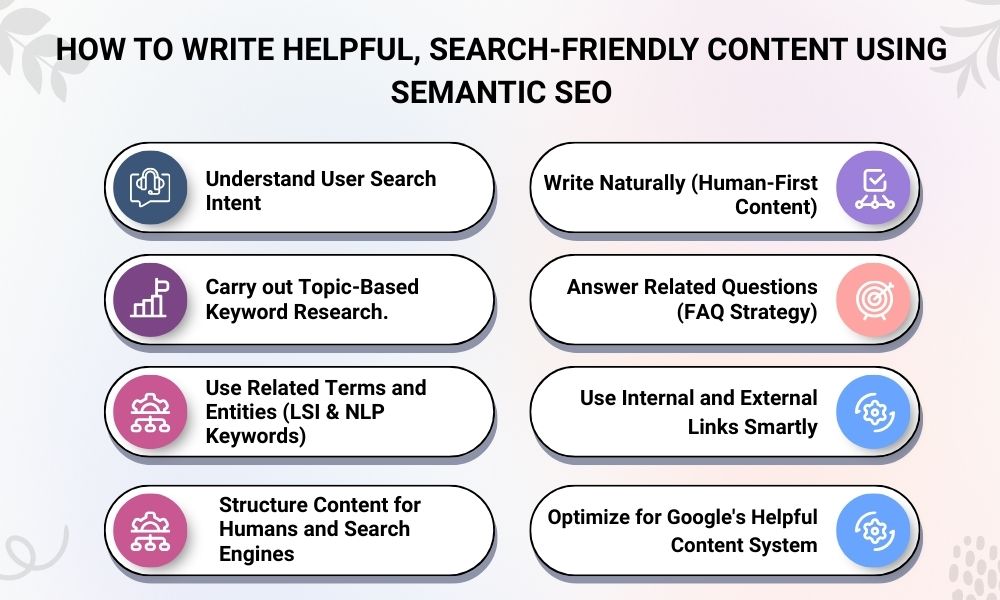
1. Understand User Search Intent
Before writing, identify why users are searching.
Common intent types:
- Informational: What is semantic SEO?
- Navigational: The best SEO tools for content writing.
- Transactional: Outsource SEO content writer.
- Comparative: Semantic SEO and keyword SEO.
Correlate content with the intent.
2. Carry out Topic-Based Keyword Research.
Don’t use a single keyword and create a keyword cluster.
Primary keyword:
- Semantic SEO guide
Keywords that are easy to rank (easy to support):
- What is semantic SEO
- Content writing in semantic SEO.
- Writing content that is search-friendly.
- How to write helpful content
- Semantic SEO best practices
- Optimization of search engine content.
- Utilize them, do not impose them.
Use these naturally, not forcefully.
3. Use Related Terms and Entities (LSI & NLP Keywords)
Search engines expect relevant concepts.
For Semantic SEO, include:
-
Content relevance
-
Google Helpful Content update
-
Topical authority
-
Content optimization
-
User experience (UX)
-
Internal linking
These help search engines better understand your content.
4. Structure Content for Humans and Search Engines
Good structure improves readability and rankings.
Best practices:
-
Use clear H2 and H3 headings
-
Short paragraphs (2–4 lines)
-
Bullet points for clarity
-
Simple, conversational language
Example:
5. Write Naturally (Human-First Content)
Avoid robotic SEO writing.
❌ Bad example:
Semantic SEO guide semantic SEO content semantic SEO strategy…
✅ Good example:
Semantic SEO helps search engines understand the meaning behind your content, making it easier to rank for multiple related searches.
Write as if you’re explaining the topic to a real person.
6. Answer Related Questions (FAQ Strategy)
Including FAQs boosts:
-
Featured snippets
-
Long-tail keyword rankings
-
User satisfaction
Example FAQs:
What is semantic SEO in simple words?
Semantic SEO focuses on meaning and context rather than exact keywords, helping content rank for related searches.
Is semantic SEO better than keyword SEO?
Yes. Semantic SEO includes keyword SEO but goes further by covering topics comprehensively.
7. Use Internal and External Links Smartly
-
Internal links: Connect related articles on your site
-
External links: Reference trusted sources (Google, Moz, Ahrefs)
This improves:
-
Crawlability
-
Authority
-
User trust
8. Optimize for Google’s Helpful Content System
Google prioritizes content that:
-
It is written for humans
-
Demonstrates experience and expertise
-
Provides original insights
-
Avoids fluff and AI-like repetition
Ask yourself:
“Would this content still be useful if search engines didn’t exist?”
If yes, you’re doing Semantic SEO correctly.
Common Semantic SEO Mistakes to Avoid
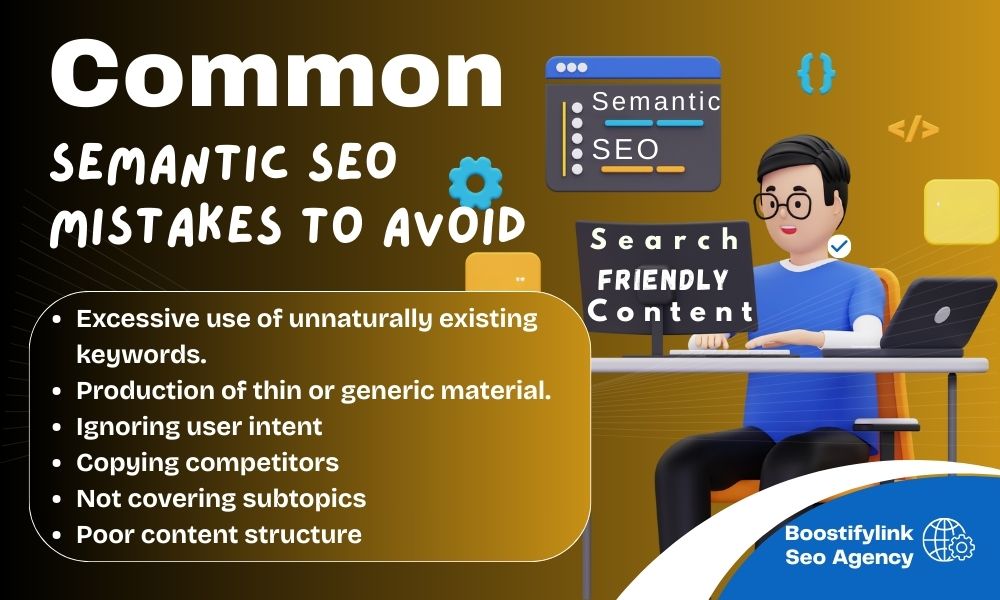
- Excessive use of unnaturally existing keywords.
- Production of thin or generic material.
- Ignoring user intent
- Copying competitors
- Not covering subtopics
- Poor content structure
Concluding Remarks: Semantic SEO Is the Future of Writing Content.
Semantic SEO is not a trick or a shortcut; it is the philosophy of content. By focusing on subjects, purpose, and utility, you automatically produce content that search engines can trust and users appreciate.
Semantic SEO at the heart of your content strategy should work if you are interested in long-term rankings, increased engagement, and sustainable traffic.