
Introduction: Why You Are Having a Hard Time Ranking (It Is Not Your Content)
You write, you have headings, you put pictures — but you are on page 3, or even below.
It is among the most popular SEO issues, particularly with new or less authoritative websites.
It is the perception of competition among keywords, rather than the quality of the content.
The majority of beginners (and even many professionals) aim for high-competition keywords dominated by large websites. It is wiser to seek low-competition keywords, those searched by people rather than most competitors.
The good news?
You don’t need paid tools to find them.
This guide shows step-by-step how to find low-competition keywords using only free tools—the same methods SEO experts use to rank faster.
What Are Low-Competition Keywords? (Simple Explanation)
Low-competition keywords are search terms that:
-
Have real search demand
-
Are not dominated by high-authority websites
-
They are often long-tail or problem-based
-
Can rank with basic on-page SEO
Example:
❌ Hard keyword: SEO tools
✅ Low-competition keyword: best free SEO tools for small blogs
The second keyword has:
-
Clear intent
-
Lower competition
-
Higher chance to rank
Why Low-Competition Keywords Matter More Than Search Volume
Many people chase high-volume keywords—but this is a mistake.
Low-competition keywords help you:
-
Rank faster
-
Get targeted traffic
-
Build topical authority
-
Increase indexing & crawl priority
-
Improve CTR and conversions
💡 20 keywords with 100 searches each often outperform 1 keyword with 5,000 searches that never ranks.
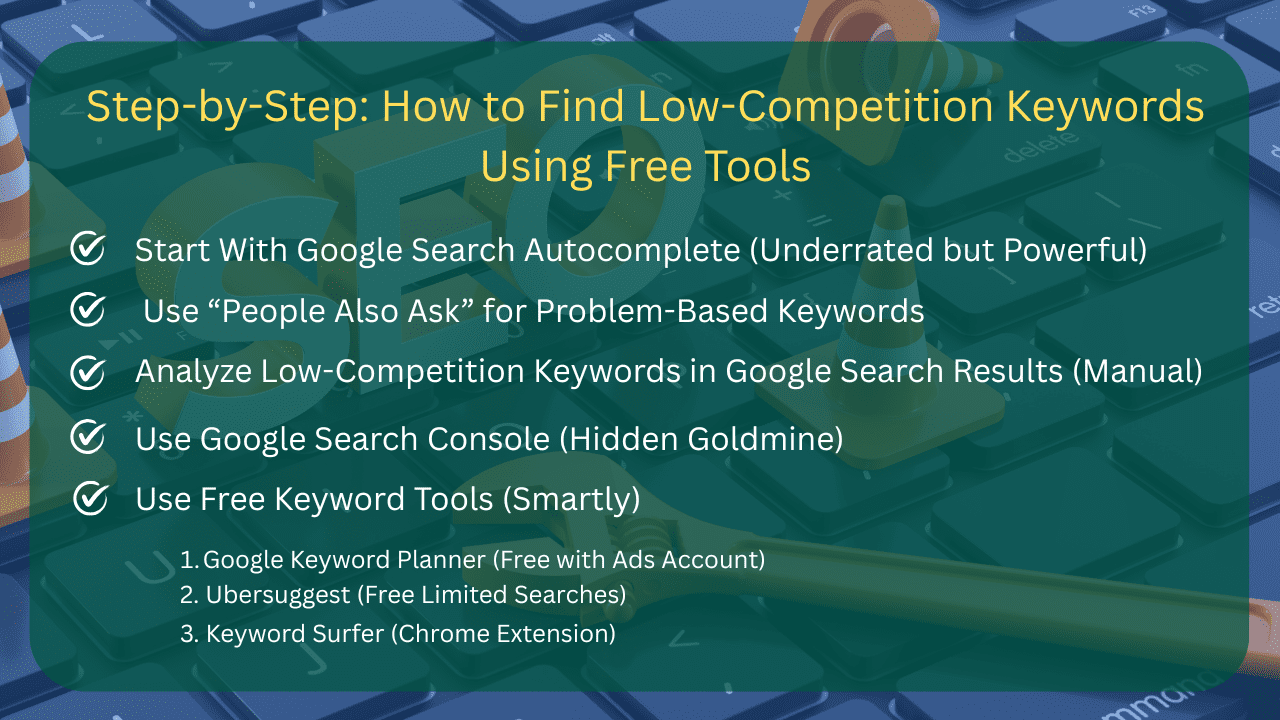
Step-by-Step: How to Find Low-Competition Keywords Using Free Tools
Step 1: Start With Google Search Autocomplete (Underrated but Powerful)
Go to Google and start typing your main topic.
Example:
Type: how to find keywords for
Google will suggest real searches like:
-
How to find keywords for SEO for free
-
How to find keywords for blog posts
-
How to find keywords for low competition
👉 These suggestions come from real user searches, making them gold.
Pro tip: Add words like:
-
how
-
best
-
free
-
for beginners
-
without paid tools
Step 2: Use “People Also Ask” for Problem-Based Keywords
Search your topic and scroll to People Also Ask (PAA).
Example questions:
-
How do I find low-competition keywords?
-
Are free keyword tools accurate?
-
What is the easiest keyword research method?
Each question is a ready-to-rank keyword.
💡 Tip: Click on one question—Google expands more related questions.
Step 3: Analyze Low-Competition Keywords in Google Search Results (Manual but Accurate)
Search for your keyword and analyze page 1 results.
A keyword is likely low competition if you see:
-
Forums (Quora, Reddit)
-
Small blogs
-
Weak or short articles
-
Poorly optimized titles
-
No exact keyword match in titles
❌ If page 1 is full of:
-
Ahrefs, HubSpot, Semrush, Wikipedia
→ Skip it (high competition)
Step 4: Use Google Search Console (Hidden Goldmine)
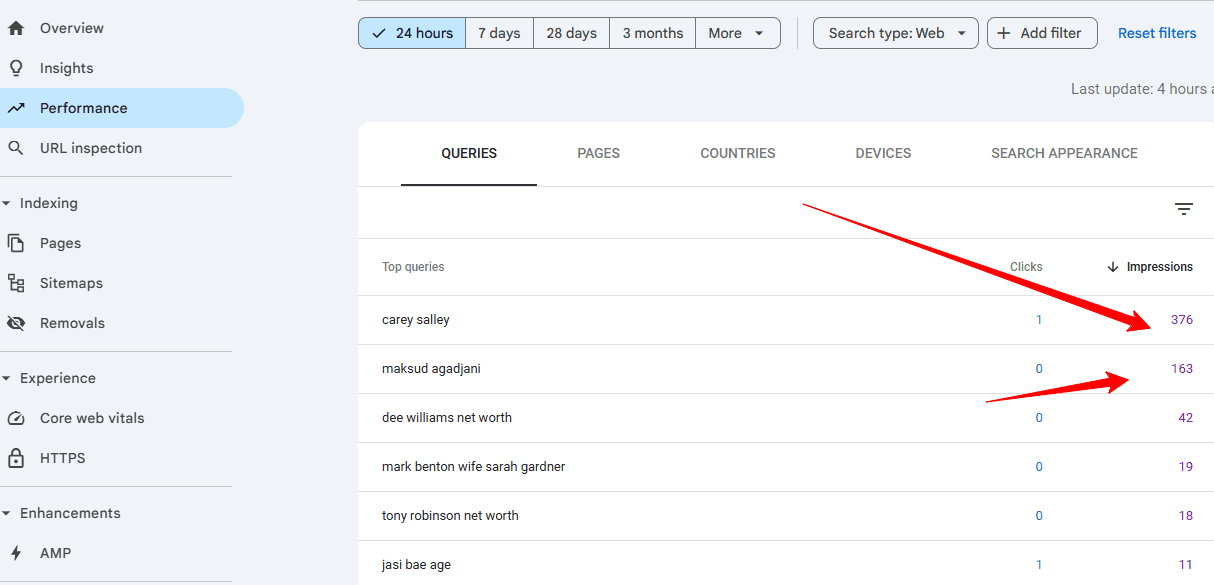
If your site is already live, GSC is one of the best free seo tools.
Go to:
Search Console → Performance → Search results
Look for:
-
Keywords with impressions but low clicks
-
Average position 8–30
These keywords mean:
✔ Google already trusts your site
✔ You’re close to ranking
✔ Optimization can push you to page 1
Create new articles or optimize existing ones around these terms.
Step 5: Use Free Keyword Tools (Smartly)
Here are practical free tools (no spam, Google-safe):
1. Google Keyword Planner (Free with Ads Account)
-
Focus on low competition labels
-
Ignore high CPC keywords initially
2. Ubersuggest (Free Limited Searches)
-
Look for:
-
SEO difficulty below 30
-
Long-tail keywords
-
3. Keyword Surfer (Chrome Extension)
-
Shows volume directly in Google
-
Helps validate autocomplete keywords
💡 Use tools for confirmation, not ideas. Google itself gives the best ideas.
How to Validate a Low-Competition Keyword (Quick Checklist)
Before writing, ask:
✅ Is the keyword long-tail (3–6 words)?
✅ Does page 1 include weak content?
✅ Is the intent clear (informational or problem-solving)?
✅ Can I write something better and more helpful?
If YES → write the article.
Common Mistakes That Stop Rankings (Avoid These)
❌ Chasing high-volume keywords only
❌ Ignoring search intent
❌ Copying competitor content
❌ Writing short, generic articles
❌ Not building topical clusters
Low-competition keywords still need quality content—not shortcuts.
How to Structure Content to Rank Faster
For each keyword:
-
Use keyword in title + H1
-
Add problem-solution format
-
Use FAQs (great for snippets)
-
Add internal links
-
Keep content helpful, not fluffy
Google does not reward keyword stuffing; instead, it rewards clarity and usefulness.
Concluding Remarks: Low-Competition Keywords Are Your SEO Quickfix.
When you are not ranking, it is time to change your keyword strategy rather than fault Google.
Free tools give you low-competition keywords that enable you to:
-
Build traffic without a budget
-
Rank faster than competitors
-
Grow authority naturally
👉 Optimize on real issues, real searches, and real value; that is how the SEO will work in 2026 and beyond.
FAQs (SEO-Friendly)
Q1: Can I really rank using free keyword tools?
Yes. Google itself is the most potent free keyword tool when used correctly.
Q2: How many low-competition keywords should I target?
Start with 20–30 keywords in one niche and build content clusters.
Q3: Are low-competition keywords low traffic?
Individually, yes, but combined, they drive consistent, high-quality traffic.
Q4: How long does it take to rank?
Typically 2–8 weeks, depending on content quality and competition.