
The importance of anchor text to search engines that can interpret links and their content is significant. When properly employed, it enhances search visibility and content relevance and adds to a natural link profile. When not used correctly, though, it may send an over-optimisation signal and negatively affect long-term SEO.
This guide explains anchor text best practices, why they matter, and how to use them in ways that are helpful to readers and safe for search engines.
What Is Anchor Text?
Anchor text is the clickable text in a hyperlink. It provides context to both users and search engines about the page being linked.
Example:
Learn more about search engine optimization basics
In this example, “search engine optimization basics” is the anchor text.
Anchor text is not an optimisation shortcut for search engines. This is the reason why natural usage is more important than exact matching.
Why Anchor Text Matters for SEO
Anchor text helps search engines:
Understand the relationship between pages
Identify content relevance
Evaluate the naturalness of a link profile
For users, anchor text:
Improves navigation
Sets clear expectations
Enhances content readability
Well-optimised anchor text supports long-term SEO growth without triggering spam signals.
Types of Anchor Text You Should Know
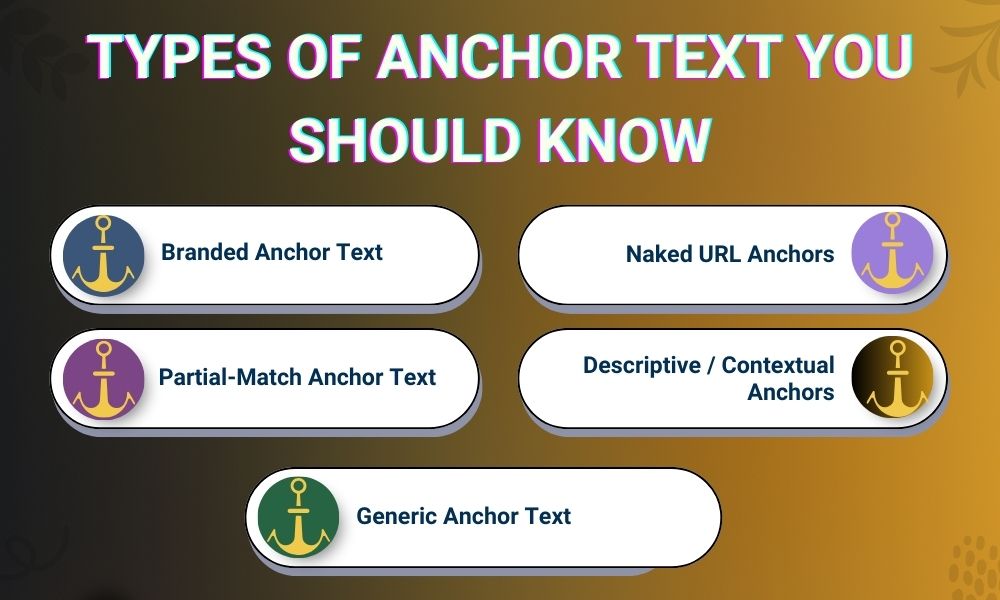
Understanding the different types of anchor text helps you create a balanced, natural link profile.
1. Branded Anchor Text
Uses a brand name.
Example:
BoostifyLink
Best for: Trust, branding, natural profiles
2. Partial-Match Anchor Text
Includes a keyword variation within a phrase.
Example:
Anchor text best practices guide
Best for: Relevance without over-optimisations
3. Generic Anchor Text
Non-descriptive phrases.
Example:
learn more
Read this article
Best for: Natural diversity
4. Naked URL Anchors
Plain URLs are used as anchors.
Example:
Best for: Natural mentions and citations
5. Descriptive / Contextual Anchors
Explain the topic naturally within a sentence.
Example:
How search engines evaluate links
Best for: User experience and semantic relevance
Anchor Text Best Practices for Natural SEO
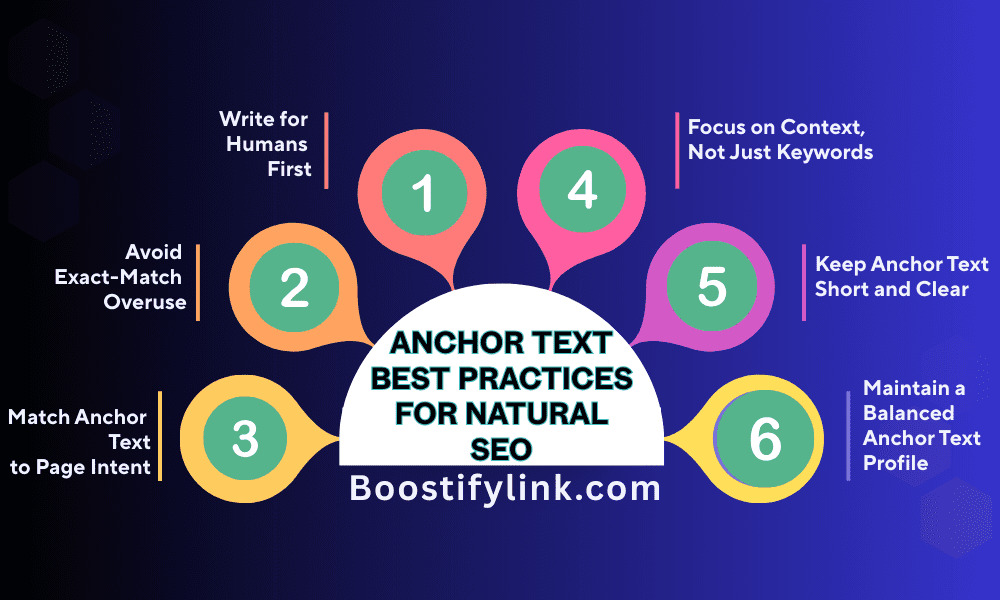
1. Write for Humans First
Anchor text should feel natural within the sentence. If it sounds forced, it probably is.
✅ Good:
This guide explains how anchor text affects SEO performance.
❌ Bad:
Learn anchor text best practices SEO anchor text guide here.
2. Avoid Exact-Match Overuse
Repeating the exact keyword-rich anchor text can signal manipulation.
Instead, use:
Synonyms
Variations
Contextual phrases
This supports semantic SEO and natural linking.
3. Match Anchor Text to Page Intent
Your anchor text should accurately reflect the content of the linked page.
For example:
Use informational anchors for guides
Use branded anchors for company pages
Misleading anchors reduce trust and usability.
4. Focus on Context, Not Just Keywords
Search engines evaluate surrounding text, not just the anchor itself.
Contextual relevance improves:
Content clarity
Link value
Search-friendly signals
5. Keep Anchor Text Short and Clear
Long or awkward anchor text can reduce readability.
Best practice:
2–6 words
Clear meaning
Natural flow
6. Maintain a Balanced Anchor Text Profile
A healthy link profile includes:
Branded anchors
Generic anchors
Partial-match anchors
Contextual phrases
This balance supports safe, long-term SEO performance.
Common Anchor Text Mistakes to Avoid
Overusing keyword-rich anchors
Using the same anchor repeatedly
Linking unrelated content
Stuffing anchors unnaturally
Ignoring user experience
These mistakes can weaken link quality and trust.
Anchor Text and Google’s Guidelines
Google does not penalise anchor text itself — it penalises manipulative patterns.
Safe anchor text usage:
Is natural
Adds value to readers
Fits the content context
Supports helpful navigation
Following best practices aligns with Google’s Helpful Content and Spam policies.
How Anchor Text Supports Long-Term SEO
When used correctly, anchor text helps:
Strengthen topical relevance
Improve internal linking structure
Support content discoverability
Build trust with search engines
It is not about ranking faster — it’s about ranking sustainably.
Final Thoughts
The anchor text is such a little piece of information that has a considerable effect. Keeping it simple, relevant, and natural will enable you to create links that work to your advantage and to the search engines.
The idea is not to optimize all anchors – it is to establish valuable relationships among content which make sense.
Anchor text that is natural to the reader generally works well in the case of SEO, as well.