
Long-tail keywords are one of the most valuable opportunities in today’s SEO landscape, particularly for small sites, new companies, niche websites, and companies that have to compete with established brands.
Whereas traditional SEO strategies target generic keywords like SEO, shoes, or digital marketing, long-tail SEO targets more specific queries, such as how to select keywords for a small business or the best running shoes for beginners with flat feet.
These searches may not have as many individual visitors, but they can be more indicative of search intent. However, when used effectively, long-tail keywords can help you attract relevant traffic, build topical authority, and uncover content ideas that even broader keyword research may lack.
So, what are long-tail keywords?
Long-tail keywords are specific phrases usually used less frequently that searchers seek.
For example:
- SEO → broad keyword
- SEO keyword research → more specific
- how to find long-tail keywords for SEO → long-tail search query
Long-tail doesn’t just refer to a certain number of words. It’s possible for a short keyword to have fairly low search volume, and for a longer phrase to have high search volume. The key issue is the positioning of the keyword in the search demand curve, and the specificity of the query.
However, in the real-world of practical SEO, long-tail keywords tend to be more specific since users look to add extra terms to clarify exactly what they’re searching for.
What Is a Long-Tail Keyword Example?
Consider a website selling running shoes.
A broad keyword could be:
running shoes
A more specific keyword could be:
best running shoes for beginners
An even more specific search might be:
best running shoes for beginners with flat feet
The final query tells you much more about what the searcher wants. Someone searching for it is not simply researching running shoes; they have a particular requirement.
Other examples include:
- best budget laptops for students
- how to improve WordPress website speed
- affordable SEO services for small businesses
- best restaurants near Islamabad for families
- how to find long-tail keywords for local SEO
- long-tail keywords for ecommerce product pages
These specific searches can be valuable because the content can be created around a clearly defined problem or goal.
What Is a Common Benefit of Long-Tail Keywords?
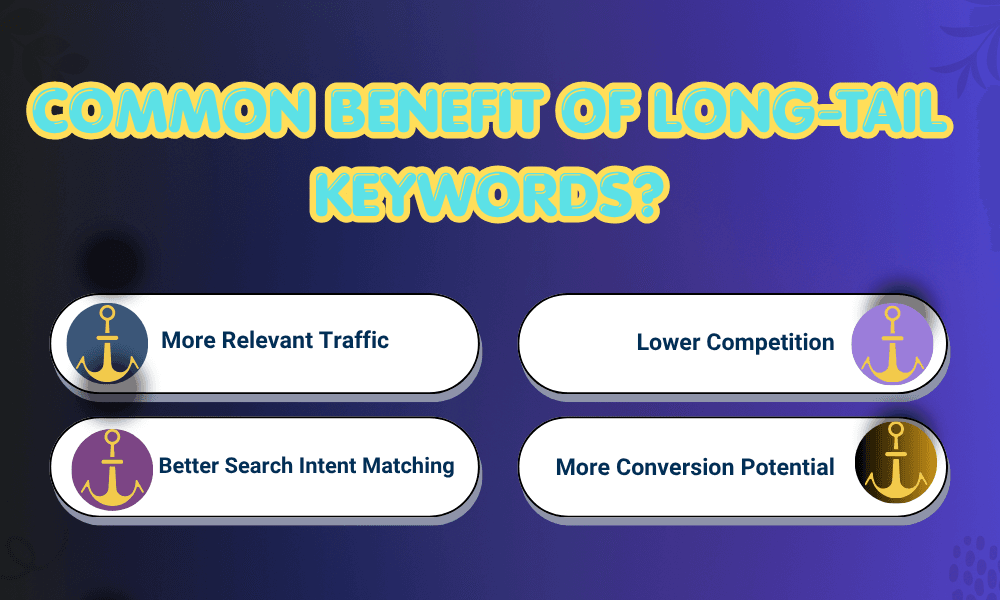
The most common benefit of long-tail keywords is more specific search intent.
Because the query contains more detail, it is often easier to understand what the searcher needs. Long-tail keywords can also be less competitive than broad terms, although this is not guaranteed for every query.
Other benefits include:
1. More Relevant Traffic
A page targeting a specific query can attract visitors who are looking for exactly that information, product, or service.
2. Lower Competition
Many long-tail searches have fewer competing pages than broad head terms. This can make them realistic opportunities for smaller websites.
3. Better Search Intent Matching
A specific query gives you more information about the searcher’s goal, allowing you to create content that directly answers their question.
4. More Conversion Potential
Commercial long-tail searches can indicate that someone has already narrowed down what they want. For example, “buy waterproof hiking shoes size 10” demonstrates a much more specific intent than simply searching for “shoes.”
However, long-tail keywords should not automatically be considered “high-converting.” Conversion depends on the query, audience, industry, landing page, offer, and user journey.
Long-Tail vs. Short-Tail Keywords
The difference is mainly specificity and search demand.
| Short-Tail Keyword | Long-Tail Keyword |
|---|---|
| SEO | SEO strategy for small businesses |
| laptops | best laptops for college students |
| running shoes | best running shoes for beginners |
| web hosting | affordable WordPress hosting for small business |
| local SEO | how to do local SEO for a small business |
Short-tail keywords can bring significant traffic, but they are usually broader and can be highly competitive.
Long-tail queries may bring fewer visitors individually, but a website can target many relevant long-tail topics and generate substantial traffic collectively.
Why Long-Tail Keywords Matter for SEO in 2026
Search behavior continues to become more conversational and specific. People increasingly use complete questions and detailed descriptions when looking for information.
This makes long-tail SEO particularly useful for content that answers questions, solves problems, compares options, or provides step-by-step instructions.
However, the goal should not be to create a separate page for every slightly different keyword variation.
Google recommends creating helpful, reliable, people-first content rather than producing content primarily for search-engine traffic.
If several long-tail queries have the same search intent, one comprehensive page may be better than several thin pages.
How to Find Long-Tail Keywords
There are several effective ways to find long-tail keyword opportunities.
1. Use Google Search Console
Google Search Console is one of the most valuable sources because it shows the actual queries that have generated impressions and clicks for your website.
Look for queries that:
- have impressions but few clicks
- rank around positions 8–20
- contain specific questions
- reveal topics missing from your existing content
- show strong relevance to your business
- represent related subtopics you have not covered
For example, if your article about long-tail SEO receives impressions for “how to identify long-tail keywords for local SEO,” that is a strong signal that readers are interested in the local SEO angle.
Instead of forcing that exact phrase repeatedly into the article, create a useful section that genuinely answers the question.
2. Use Google Autocomplete
Start typing your main topic into Google and examine the suggestions.
For example:
long-tail keywords…
Google may suggest searches related to:
- long-tail keywords for SEO
- long-tail keywords examples
- long-tail keywords for local SEO
- long-tail keyword research
- long-tail SEO strategy
These suggestions can reveal how people naturally phrase their searches.
3. Check “People Also Ask”
Question-based results can provide excellent content ideas.
Look for questions beginning with:
- What
- Why
- How
- When
- Where
- Can
- Do
These can become useful H2 or H3 sections when they are closely related to your main topic.
4. Study Competitors
Look at pages ranking for your main keyword and identify subtopics they cover.
Do not simply copy their headings. Instead, identify gaps and create a more useful resource that answers the questions your audience actually has.
5. Use Keyword Research Tools
SEO tools can help identify search volume, keyword difficulty, related terms, SERP features, and variations.
Use these metrics as guidance rather than absolute rules. A keyword with very low reported volume can still bring valuable traffic, while a high-volume keyword may be irrelevant to your business.
Where Should You Include Long-Tail Keywords on a Website?
Long-tail keywords can naturally appear in several important areas of a page.
Page Title
Create a clear title that describes the main topic.
H1 Heading
Your H1 should communicate the primary subject of the page.
H2 and H3 Headings
Use relevant questions and subtopics where they improve the structure of the content.
Introduction
Explain the topic naturally and make it clear what the reader will learn.
Main Content
Answer related questions naturally instead of repeating exact keyword phrases.
Internal Links
Use descriptive anchor text when linking to relevant pages.
Meta Description
Write a useful description that encourages qualified searchers to click.
Google’s Search Essentials recommends using words people would use to search for your content in prominent and descriptive locations, while still focusing on useful content and good page experience.
Long-Tail Keywords for Local SEO
Long-tail SEO can be particularly useful for local businesses.
Instead of targeting only:
plumber
a local business might target:
emergency plumber in Rawalpindi
or:
24-hour plumber near Islamabad
Similarly:
SEO agency
could become:
affordable SEO agency for small businesses in Islamabad
Local long-tail keywords can combine:
- service
- location
- customer type
- problem
- urgency
- product or service requirement
The key is to create genuinely useful local content rather than creating dozens of nearly identical pages for different locations.
Can Long-Tail SEO Work for Small Businesses and Startups?
Yes.
Long-tail SEO can be especially useful for smaller websites because it allows them to focus on specific topics rather than immediately competing for extremely broad keywords.
For example, a new website may struggle to rank for:
digital marketing
but could build visibility around:
digital marketing strategies for local restaurants
As the website gains relevant content, links, authority, and visibility, it can gradually expand toward broader topics.
There is no guarantee that every long-tail keyword will be easy to rank for. Some specific queries can still have strong competition.
Do Long-Tail Keywords Rank Faster?
Not necessarily.
This is an important misconception.
A long-tail keyword may be easier to target because it is specific and has less competition, but ranking speed depends on many factors, including:
- competition
- content quality
- search intent
- website authority
- backlinks
- internal linking
- technical SEO
- relevance
- overall site quality
Therefore, do not choose a long-tail keyword simply because you expect it to rank quickly.
Choose it because it represents a valuable topic or search intent that your website can satisfy better than competing pages.
How Long-Tail Keywords Help Build Topical Authority
Long-tail keywords can help you cover different aspects of a broader subject.
For example, a website targeting local SEO could create useful content around:
- local SEO basics
- Google Business Profile optimization
- local keyword research
- long-tail keywords for local SEO
- local SEO for small businesses
- local link building
- local citations
- local SEO reporting
Together, these related topics can demonstrate broader topical coverage.
However, topical authority does not mean publishing dozens of pages simply to target keyword variations. If several queries have the same intent, one strong page may be more useful than multiple repetitive articles.
How Long-Tail Keyword Data Can Improve User Experience
Search data can tell you what visitors expect to find.
Suppose users reach your article after searching:
“how can I use long-tail keyword data to improve the user experience on my website?”
That query suggests the visitor wants more than a definition. They want a practical process.
You could respond by explaining how to:
- Review actual search queries.
- Identify unanswered questions.
- Add useful sections to existing pages.
- Improve navigation and internal links.
- Clarify confusing content.
- Update pages based on new search behavior.
This creates a better experience because the content responds to real questions rather than simply containing more keywords.
Long-Tail Keywords and Link Building
Long-tail SEO can also influence your link-building strategy.
Rather than trying to build a separate backlink campaign for every long-tail phrase, create valuable resources that naturally deserve links.
For local businesses, useful link opportunities can include:
- local organizations
- relevant industry websites
- business directories
- community resources
- local publications
- niche websites
- useful guides and statistics
The objective should be to build authority around your website and important topics, not manipulate rankings by acquiring links for individual keyword phrases.
Common Long-Tail SEO Mistakes
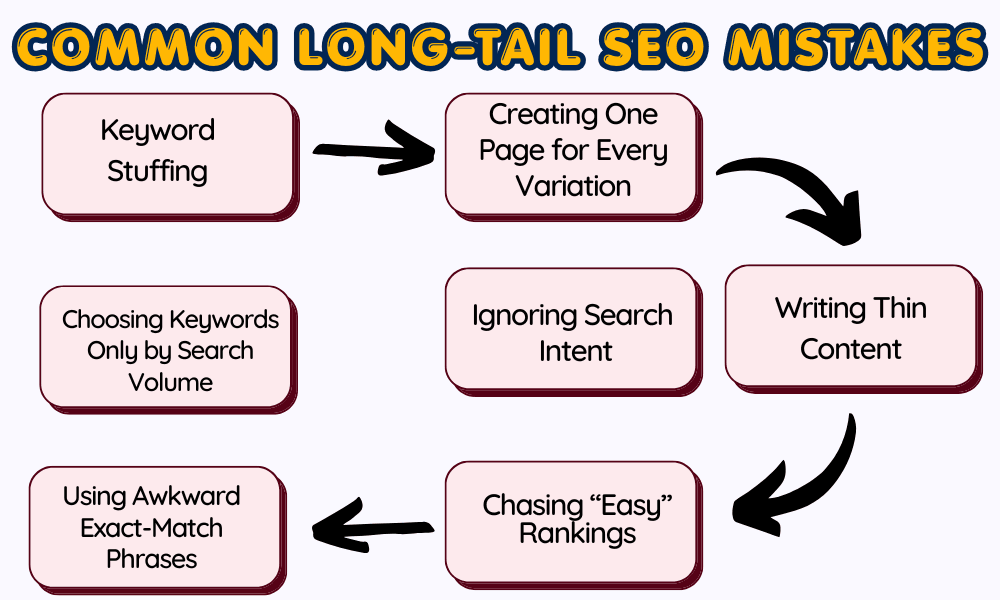
Avoid these common mistakes when building a long-tail strategy:
Keyword Stuffing
Do not repeat the same long-tail phrase unnaturally.
Creating One Page for Every Variation
Similar queries often belong to the same topic and can be answered by one comprehensive page.
Choosing Keywords Only by Search Volume
Search volume is useful, but relevance and intent are equally important.
Ignoring Search Intent
A keyword is valuable only when your content matches what the searcher actually wants.
Writing Thin Content
Adding a keyword to a short page does not make the page useful.
Using Awkward Exact-Match Phrases
Write naturally. Search engines can understand related terms and variations.
Chasing “Easy” Rankings
There is no guaranteed ranking formula. Even a low-volume query can be competitive.
A Simple Long-Tail SEO Strategy for 2026
A practical long-tail strategy can follow this process:
1. Find: Discover specific queries using Search Console, Google, keyword tools, competitors, and customer questions.
2. Group: Combine keywords that have the same search intent.
3. Prioritize: Choose topics based on relevance, business value, competition, and your ability to provide a strong answer.
4. Create or Improve: Build useful content that completely addresses the topic.
5. Optimize Naturally: Use relevant phrases in titles, headings, content, links, and other descriptive areas where appropriate.
6. Connect: Add relevant internal links between related pages.
7. Measure: Monitor impressions, clicks, rankings, engagement, and conversions.
8. Update: Use new search data to identify unanswered questions and improve the page.
This approach is more sustainable than publishing separate articles for every keyword variation.
Final Takeaway
Long-tail keywords are not simply long phrases with four, five, or six words. They are more specific search opportunities that often have lower individual search demand and can provide valuable insight into what people actually want.
Their biggest advantage is specificity.
Long-tail SEO can be leveraged to gain more relevant traffic and topical coverage by understanding search intent, analyzing actual Search Console queries, researching customer queries, and creating in-depth content.
Long-tail keywords can realistically offer a small business and newer websites the chance to rank for specific queries. However, no shortcuts are possible: ranking is still based on relevance, quality, authority, and usefulness of the content.
The best long-tail SEO strategy for 2026 is simple:
Find specific problems → understand the intent → create genuinely useful content → connect related topics → measure results → improve continuously.
That approach helps both search engines and real users understand why your content deserves to be found.