
Research on keywords is often considered a technical SEO technique, yet to a layman, it is not as complicated as it appears. Fundamentally, keyword research is concerned with how people search and with applying that understanding to produce content that unambiguously answers underlying questions.
This manual describes keyword research in an easy-to-understand manner. It does not require any SEO tools or prior experience; it only requires a clear understanding of how users think and search.
The importance of Keyword Research to the Beginner.
Each search begins with an enquiry or necessity. Keyword research will help you identify those needs so you can address them directly in your content.
In not researching keywords, beginners will tend to:
- Write about content that no one is searching for.
- Address too general subjects.
- Difficulty of targeting the correct people.
Even the simplest form of keyword research helps make content more specific, relevant, and findable.
What Keywords Are (In Simple Terms, actually).
A keyword is any word or phrase that an individual enters into a search engine. It is intent – the thing that the user wants to know, locate, or perform.
For example:
- How to start a blog.
- keyword research tips for beginners
- Best shoes for walking
Keywords do not deal with repetition. They are concerned with knowing what people type when they search.
How Search Engines Use Keywords Today
Search engines do not depend on an exact match or a repeated phrase to realize the subject of a page, but instead use keywords to comprehend the subject of a web page.
Instead, they look for:
- Clear topic coverage
- Relevant explanations
- Relevant search intent content.
This shows that natural writing and clarity are more important than word repetition.
An Easy, Step-by-Step Guide to Keyword Research for Beginners.
Novice users do not have to rely on sophisticated equipment; instead, they can be guided through a simple process that also aids them in real-life scenarios.
Step 1: Begin with a single Clear topic.
Select the subject to write about that you know. This may be a skill, a question, or an issue of your audience.
Examples:
- keyword research
- SEO basics
- content writing
It is best to begin with topics to avoid disjointed material.
Step 2: Think Like Your Reader
Before searching using keywords, ask yourself how a novice would direct their query.
Ask yourself:
- What would I type if I were new?
- What am I trying to learn?
- What problem do I want solved?
This action makes keyword research user-oriented.
Step 3: Use Google as Your Research Tool
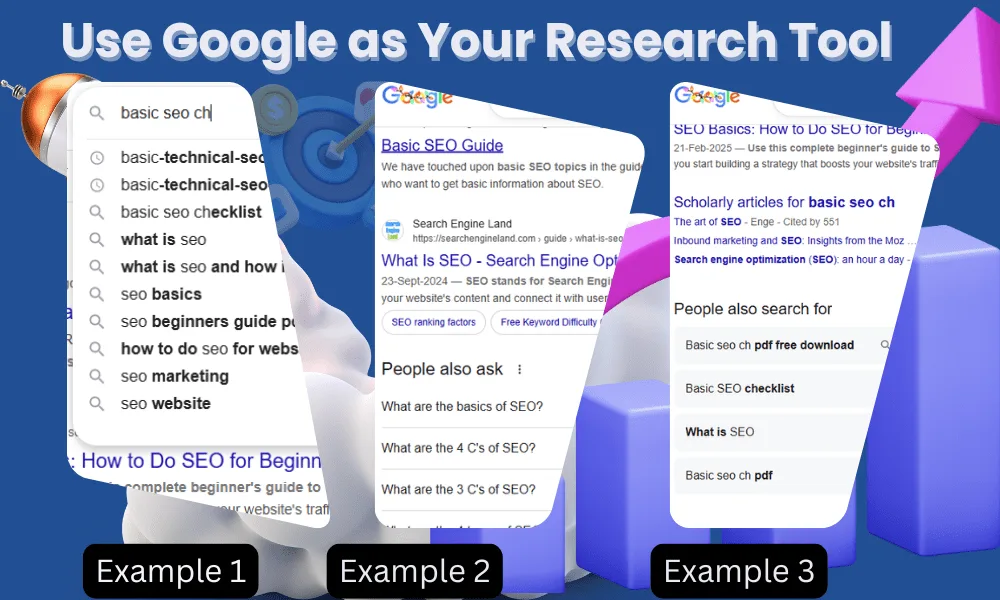
Go to Google and type up your topic and see:
- Search recommendations upon typing.
- Questions in People Also Ask.
- Similar searches at the bottom of the page.
These concepts are based on actual searches, making them reliable and easy to follow for a beginner.
Step 4: Choose Specific, Realistic Keywords
Do not use general terms that are hard to compete with. Novices will like more specific phrases that elaborate intent.
For example:
-
Instead of “SEO,” choose “SEO basics for beginners.
-
Instead of “keyword research,” choose “keyword research tips for beginners
Specific keywords can be more convenient to address and valuable to the readers.
Step 5: Become familiar with Search Intent.
Every keyword represents the cause of the search. A few users desire to learn, and others to compare or act.
For novice content, target keywords for which users are clearly seeking explanations or instructions. Relevance The relevance is enhanced by matching intent.
Step 6: Design one page of focus on each subject.
Newcomers tend to create individual pages for similar keywords. It is preferable to discuss the associated concepts in a single, clear, and well-organized article.
This helps search engines better understand the search topic and prevents redundant duplication.
Step 7: Be Natural in the Use of Keywords in Writing.
Keywords are supposed to fit in your writing. They belong in:
- The page title
- Section headings
- The introduction and the body text were necessary.
In case a sentence is stressed, rephrase it. Natural language is always preferred.
Step 8: Check the content before publicity.
Before publishing, ask:
- Can someone new understand this material?
- Does it respond to the searcher’s query?
- Do you find it easy to read and understand?
In case the response is yes, the material is prepared.
Real Beginner Examples of Keyword Research
To simplify this process further, here are some simple examples beginners can relate to.
Example 1: Writing About SEO Basics
The first-time writer is interested in writing about SEO but believes that the subject is too general. They search Google Suggest and find that people learning need some beginner explanations.
They choose to focus on:
- SEO basics for beginners
This is what makes the article more specific and helpful.
Example 2: Writing About Keyword Research
Instead of writing a general article on keyword research, a beginner notices searches focused on learning and simplicity.
They write:
- Keyword research tips for beginners with no SEO experience
This is the most appropriate for user intent.
Example 3: Small Business Website
The local bakery does not have to compete with generic terms; it can focus on location- and service-related searches.
They target phrases like:
- Custom cakes in [city]
This strategy attracts more relevant visitors to the board.
Common Keyword Research Mistakes Beginners Should Avoid
- Using keywords just because they appear to be popular.
- Disregarding the real needs of what the users want to learn.
- Composing several pages on a subject.
- Coercing keywords to sentences.
Preventing such errors makes the content natural and valuable.
Final Thoughts
The research on keywords does not need to be complicated. For novices, the best approach is to understand how people search, identify relevant topics, and present information that clearly addresses questions.
By following this simple checklist and focusing on clarity instead of technical tricks, beginners can build content that is useful, trustworthy, and more likely to perform well in search results over time.