
SEO on ecommerce websites is not about tricks or algorithm chasing. It is not only about helping search engines understand your store, but also about making the experience feel realistic for real customers. With the coincidence of the two goals, ranking will become natural and sustainable.
The article outlines six practical SEO rules and best practices for ecommerce websites, along with considerations that many guides do not address. The emphasis is made on clarity, usability, and growth in the long run – not shortcuts.

1. Create Product Pages that Will Benefit the Customers.
Ecommerce SEO either works or fails on product pages. An effective product page provides clear answers to questions and eliminates hassle in the purchase decision process.
Strong product pages typically:
- Product titles should be clear and precise.
- Write original descriptions giving features, advantages, and applications.
- Bring in high-quality pictures that do not consume excessive bandwidth.
- Do not copy the manufacturer’s descriptions onto the other sites.
Customer-oriented product pages also appear to perform better in search results in the long term.
2. Use Category Pages as Major SEO Resources.
Organic traffic tends to be the best entry point through category pages, yet most ecommerce websites do not develop them.
Effective category pages:
- In a few words, what the category consists of.
- Assist customers in knowing product differences.
- They are structured logically and easy to navigate.
Having a well-organized category page enhances the user experience and site clarity, helping search engines understand your store’s structure.
3. Make the Technical Foundation Clean and Reliable.
Even good material may not work when technical issues affect accessibility or performance. Technical SEO measures that your ecommerce site runs smoothly under the hood.
Key areas to monitor include:
- Page loading speed
- Broken links or error pages
- Secure browsing with HTTPS
- Salvaging of removed or outdated URLs.
Routine maintenance will ensure that non-technical problems, such as minor technical troubles, do not become permanent ranking problems.
4. Put Mobile Users First.
Mobile hand-held devices have become the most significant source of ecommerce traffic. When a site does not work well on mobile devices, users will quickly abandon it, and search engines will notice.
An ecommerce website that is mobile-friendly must:
- Fit on multiple screens with ease.
- Have easy-to-tap buttons and readable text.
- No pop-ups blocking content.
An efficient mobile experience facilitates improved engagement, conversions, and long-term visibility.
5. Keywords: User be Smart, Not forceful.
Keywords remain an essential part of ecommerce SEO, but how they are used matters more than how often they appear.
The healthy approach to the keyword implies:
Choosing terms that match real customer intent
Placing them naturally in titles, headings, and descriptions
Avoiding repetition that disrupts readability
Search engines are good at understanding context. Explicit language and natural phrasing are far more effective than forced repetition.
6. Promote Your Store through Decision-Based Helpful Content.
Product listing is not the end of ecommerce SEO. Information that helps customers make well-informed choices builds confidence and exposure.
Examples include:
- Buying guides
- Product comparisons
- Frequently asked questions
- Clinical practice or guidelines.
Such content will assist customers at various points in the purchasing process, thereby substantiating the usefulness of your store.
Other Best Practices that Enhance Ecommerce SEO.
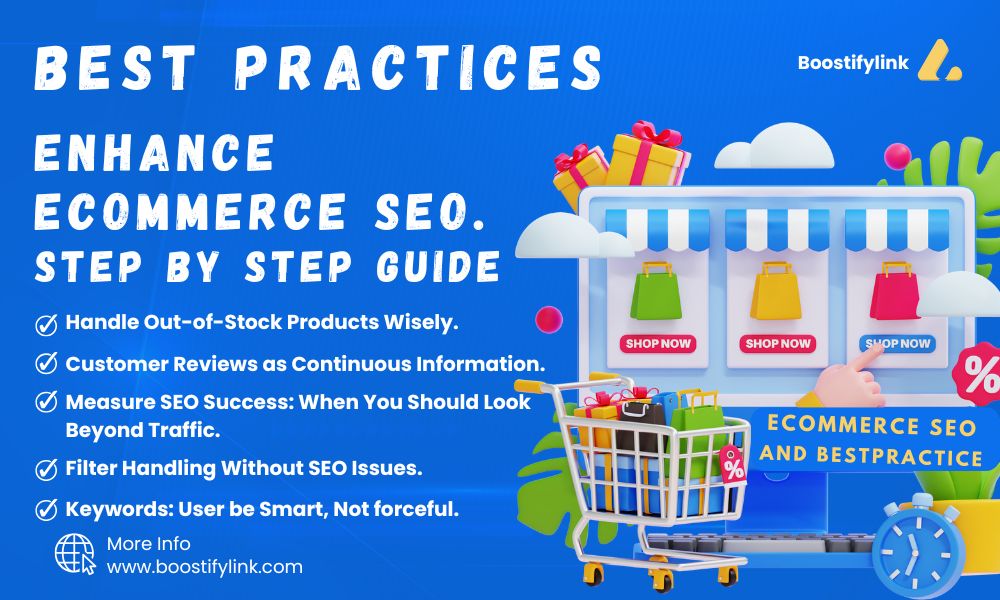
Filter Handling Without SEO Issues.
Product filters can enhance usability, but can generate duplicate or unnecessary URLs if not used with care. Not all the filtered views need to be indexed.
The goal is to:
- Maintain central category pages.
- Filter out combinations that have low-value filters, effectively junking up the search results.
- Striking the right balance between usability and readability.
This safeguards site quality and maintains an excellent browsing experience.
Handle Out-of-Stock Products Wisely.
It is normal to have out-of-stock products, but pages can be removed too quickly, resulting in this value being wasted.
Better approaches include:
- Having pages running when restocks will occur.
- Making it clear as to availability.
- Recommending other/similar products.
This helps users and search engines understand what is happening.
Customer Reviews as Continuous Information.
Customers’ reviews will gradually add new, helpful information to the product page. They also mirror the language the actual buyers speak.
Reviews are authentic and conspicuous:
- One-way pages are automatically updated.
- Trust increases
- Engagement improves
This is an asset, but not simple short-term social proof.
Measure SEO Success: When You Should Look Beyond Traffic.
Success is not basedsolely on traffic. More significant pointers are:
- Traffic on product and category pages.
- The navigation of the users around the site.
- Referred routes of organic visitors.
SEO is effective when it drives actual business performance, not just figures.
Common Mistakes Ecommerce Websites Should Avoid
- Duplicating the same product description.
- Ignoring mobile usability
- Allowing technical problems to build up.
- Optimizing the keywords rather than making them transparent.
The majority of SEO issues stem from oversights rather than from a lack of sophisticated strategies.
Final Thoughts
Ecommerce SEO is built on usability, clarity, and consistency. Online stores establish a foundation for search engines to rely on by focusing on high-quality product pages, sound structure, technical integrity, and valuable content.
It would have no shortcuts,s but there are established principles. When ecommerce websites implement these best practicesintelligently,e improved rankings and outcomes are likely to follow.