
Cybersecurity is one of the most competitive fields in the online world. Decision-makers take it step by step; their decision-making research cycles are long, and trust drives conversions. For cybersecurity companies, SEO does not only mean ranking; it also involves establishing credibility, authority, and visibility at the right moment.
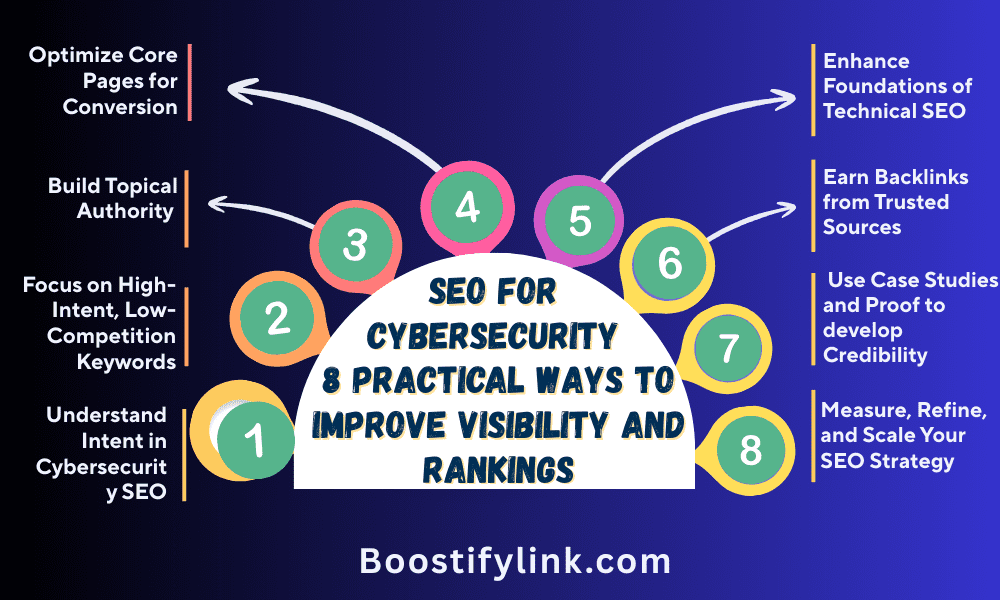
This guide breaks down 8 practical, proven SEO strategies that help cybersecurity companies enhance search visibility, attract qualified leads, and build rankings that last – all without risky tactics.
Why SEO is Difficult for Cybersecurity Companies
Before diving into solutions, it’s essential to understand the challenge:
High competition from established brands
Complex products that are hard to explain
Long sales cycles and multiple decision-makers
Google’s strong focus on EEAT (Experience, Expertise, Authority, Trust)
A generic SEO strategy won’t do it. Cybersecurity SEO needs to be strategic, educational, and trust-based.
1. Understand Search Intent in Cybersecurity SEO
Search intent is the key to successful SEO.
Cybersecurity searches are of three main types:
- Informational: “What is endpoint security?
- Commercial – “Best cybersecurity solutions for enterprise.
- Transactional – “Managed SOC services provider.
Best practice:
Map keywords to the buyer journey.
- Early stage – content education.
- Mid-stage -comparisons and use cases.
- Late-stage: service and solution pages.
When your content aligns with content intent, it is rewarded with better Google rankings.
2. Focus on High-Intent, Low, Low Competition Keywords
Trying to rank for broad terms like “cybersecurity services” is extremely difficult – especially for growing companies.
Instead, focus on long-tail, intent-driven keywords, such as:
- Cybersecurity Managed services for SMBs
- Cloud security solution for SaaS companies
- SOC services for financial institutions
Why this works:
Lower competition
Higher conversion potential
Easier to rank with focused content
These keywords may have lower search volume, but will they attract serious buyers rather than casual readers?
3. Build Topical Authority by using Expert-Led Content
Google expects expertise in cybersecurity.
To build topical authority:
Publish in-depth guides, not thin blog posts
Cover topics fully instead of chasing keywords
Use expert insights, real scenarios, and clear explanations
Content Ideas That Perform Well
- Threat analysis guides
- Compliance explainers (ISO, SOC 2, HIPAA, etc.)
- Best practices for security by industry
- Risk assessment frameworks
Tip: Topic clusters destroy standalone posts. One strong pillar page supported by other articles is better than a single strong pillar page alone and will improve rankings more quickly.
4. Achieving Highest Core Page Conversion and Trust
Ranking alone does not lead to the generation of leads – trust does.
Your service and solution pages should include the following:
- Rational explanation of what you do (don’t overload the reader with jargon)
- Benefits before features
- Industry use cases
- Security certifications and compliance badges
- Strong but non‑pushy CTAs
SEO + trust optimization:
Because the line of defence uses a descriptive H1 and H2 heading
- Add FAQs on service pages
- Have internal links to other related content
This helps improve engagement, dwell time, and conversion rates – all of which are good for SEO.
5. Enhance Foundations of Technical SEO
Technical SEO is essential for cybersecurity brands, as users expect secure, fast, and reliable websites.
Key technical SEO areas:
- HTTPS and Appropriate Security Headers
- Fast page load speed
- Clean URL structure
- Sitemap in XML, and of course, a proper indexation
- Schema for organization and services
Avoid these mistakes:
- Blocking important pages from robots.tax
- Duplicate content of service pages
- Ignore mobile optimization.
A technically sound website builds search trust and user confidence.
6. Earn Backlinks from Trusted Sources
Backlinks are still a major ranking factor; however, quality over quantity is a bigger factor.
Effective ways of link building:
Guest articles on cybersecurity blogs
Digital PR and expert commentary
Research reports and data-driven content
Partnerships with tech platforms and communities
Avoid:
- Spammy directories
- Paid link schemes
- Irrelevant guest posts
In cybersecurity SEO, a single high-quality (i.e., authoritative) backlink is more important than 10 low-quality backlinks.
7. Use Case Studies and Proof to develop Credibility
Case studies are a powerful tool to use for SEO or conversion.
Why case studies help SEO:
- Unique, original content
- Naturally has industry-specific keywords
- Helps in the improvement of engagement and trust
Best practices:
- Have a clear explanation of the problem, solution, and results
- Avoid exaggerated claims
- Include some metrics whenever possible
- Use structured headings
Google favors real-world results, especially in high-risk industries such as cybersecurity.
8. Measure, Refinement, and Scale SEO Strategy
SEO is a process, not a once-in-a-lifetime activity.
Metrics that matter:
- Organic traffic by intent
- Keywords ranking (commercial & informative)
- Conversion rate of organic traffic
- Engagement metrics (time on page, bounce rate)
Tools to use:
- Google Search Console
- Google Analytics
- Keyword tracking tools
Use data to optimize the content, grow what’s winning, and scale it.
Common SEO Mistakes Cyber Security Companies Should Avoid
- Overuse of technical jargon without explanation
- Publishing shallow content
- Ignoring trust signals
- Chasing high-volume only keywords
- Depending solely on paid traffic
Avoiding these mistakes keeps rankings relatively stable and long-term.
Conclusion: SEO Is acybersecurity long-term growth engine
SEO for cybersecurity companies is not about shortcuts. It’s about building long-term authority, trust, and visibility.
By targeting search intent, expert content, technical superbness, and credibility, cybersecurity brands can:
- Improve rankings
- Attract qualified leads
- Strengthen brand trust
- Create an anticipated channel of growth
When done correctly, SEO is one of the most reliable and cost-effective marketing strategies in a competitive industry.